In many sales organizations, creating a quote is far more complex than simply picking a product and assigning a price. Products may be configurable, pricing may vary by customer or region, discounts may require approvals, and incorrect combinations can lead to costly errors. This is where CPQ comes in.
CPQ stands for Configure, Price, Quote. It is a system that helps sales teams accurately configure products, apply the right pricing, and generate professional quotes—quickly and consistently—while enforcing business rules behind the scenes.
CPQ in the Quote-to-Cash Process
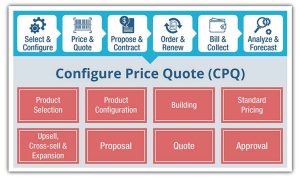
CPQ is a core part of the broader Quote-to-Cash (QTC) lifecycle. Quote-to-Cash represents the end-to-end process that starts with a buyer’s interest and ends with recognized revenue, including quoting, contracting, ordering, billing, and renewals. CPQ sits at the front of this flow, ensuring that what is sold can actually be delivered and billed correctly
In other words, CPQ helps answer three critical questions early in the sales cycle:
-
What can we sell?
-
How much should it cost?
-
How do we present it to the customer?
Configure: Building the Right Product
The Configure part of CPQ ensures that sales users can only select valid product combinations.
Modern CPQ systems support both:
-
Standalone products, and
-
Configurable products, such as bundles with optional components.
Configuration is typically driven by:
-
Products – the goods or services your company sells.
-
Categories – how products are organized in a catalog.
-
Options and option groups – selectable components within a bundle.
-
Attributes – fields used to capture details about how a product is being sold (for example, contract length or service level).
Constraint rules enforce logic during configuration, such as:
-
Preventing incompatible products from being selected
-
Automatically adding required options
-
Recommending upsell or cross-sell products
These rules help eliminate invalid quotes before they ever reach a customer
Price: Applying Consistent and Accurate Pricing
The Price component of CPQ determines how much each product or service costs.
Pricing is typically structured using:
-
Price Lists – defining base prices for groups of customers (for example, SMB vs. Enterprise, or by region or currency).
-
Price List Items – linking individual products to a price list with specific pricing details, such as recurring charges or one-time fees.
This structure allows organizations to maintain consistent pricing while still supporting flexibility for different markets and customer segments
Advanced CPQ implementations may also include pricing rules, discounting logic, and approval workflows, ensuring pricing stays within company policy.
Quote: Turning Configuration into a Customer-Ready Proposal
Once products are configured and priced, CPQ generates the Quote.
A CPQ-generated quote:
-
Reflects validated configurations
-
Uses approved pricing
-
Can be formatted into professional proposals or documents
-
Integrates directly with CRM records such as Accounts and Opportunities
In Salesforce-based CPQ solutions, quoting is deeply integrated with standard CRM objects, allowing quotes to flow seamlessly into downstream processes like contracting, ordering, and billing
Why Companies Use CPQ
Organizations adopt CPQ to solve common sales challenges:
-
Reducing quote errors
-
Shortening sales cycles
-
Enforcing pricing and discount policies
-
Enabling sales teams to sell complex products confidently
-
Improving the overall customer experience
As products, pricing models, and sales channels grow more complex, CPQ becomes less of a “nice to have” and more of a foundational sales system.
Final Thoughts
At its core, CPQ is about speed with control—empowering sales teams to move fast without sacrificing accuracy or compliance. Whether implemented as part of a full Quote-to-Cash platform or as a standalone solution, CPQ plays a critical role in modern revenue operations.

Leave A Comment